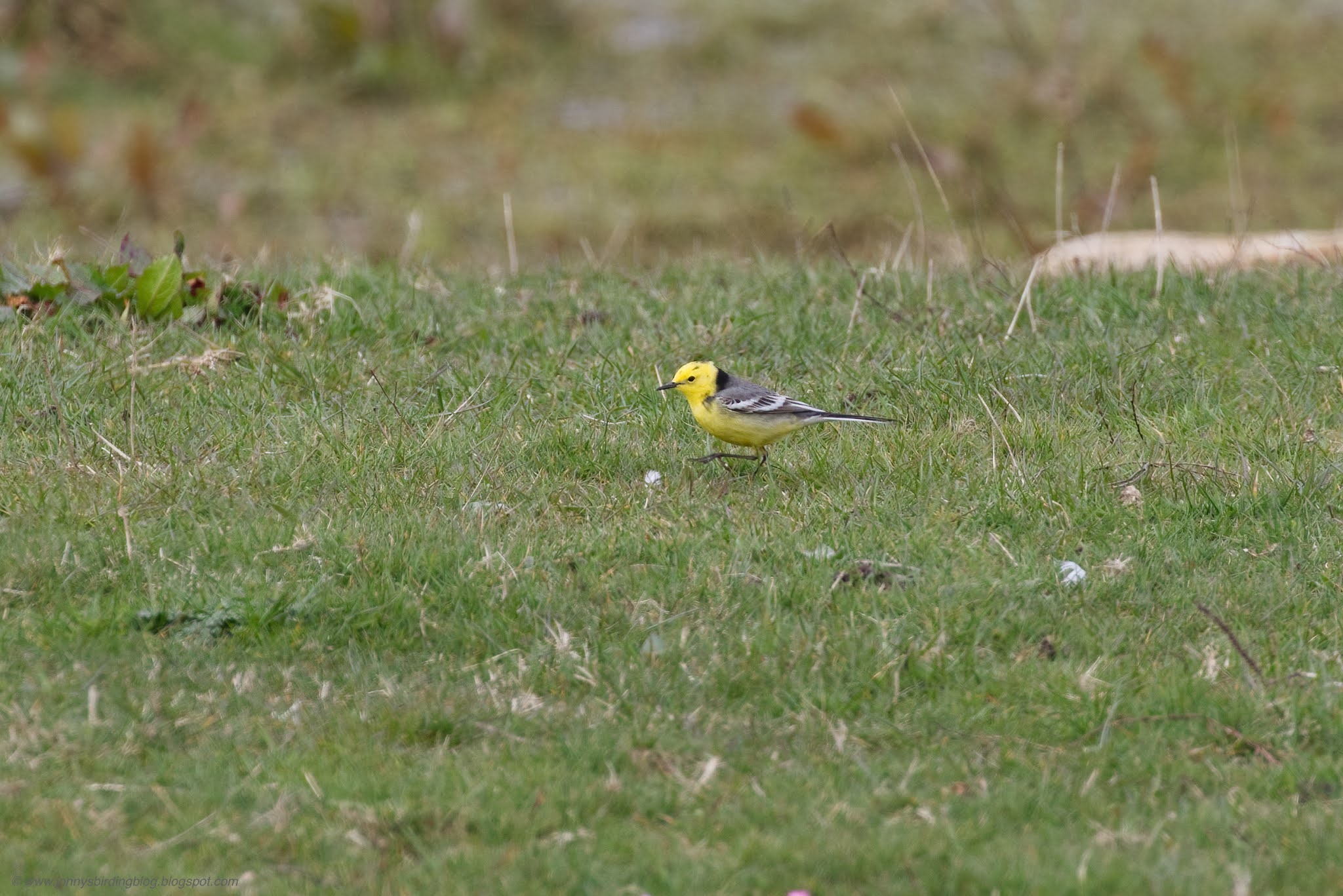
Despite less than ideal winds, spring has slowly started to get going since my last blog post. The undoubted highlight was the male Citrine Wagtail at Lynemouth Flash on the 3rd. An usual record being so early in the spring, and also because it turned up at exactly the same place as the showy female in 2017!
Other nice sightings have included the Todd's Canada Goose again, as well as an adult Greenland White-front and 3 Russian White-fronts, all in the Cresswell area, a Black Redstart at Snab Point, Glaucous Gull past East Chevington and my first Willow Warbler of the year.
Citrine Wagtail - please view the video in HD at 1080p
Todd's Canada Goose with the Pink-feet west of the hide at Cresswell
In between increasing amounts of schoolwork and editing photos from Fuerteventura, we have managed a few visits to the patch. Back at the beginning of March it was extremely quiet, except for a drake Green-winged Teal at Druridge Pools.
Last weekend things were slowly starting to pick up with a first-winter Glaucous Gull north through Druridge Pools being the highlight. An Egyptian Goose was also near Linton Pond.
Today, we headed out hoping to get some hirundines in the deteriorating weather conditions and East Chevington we were a bit surprised not to find any. However, at Druridge Bay Country Park there were at least 60 Sand Martin.
Another 10 Sand Martin were at Druridge Pools and we walked along the coal road to find the adult Bewick's Swan still among 62 Whoopers. As we watched the swan, we picked up a Great White Egret flying towards us from the west and it appeared to land on the shore of the main pool. We rushed back to the hide and at first there was no sign, but my dad picked it up in the SW corner. Unfortunately the views were pretty poor but it was nice to finally find one for ourselves!
Yesterday morning we set off on our first ever twitch to Scotland from home, hoping to catch up with the scoters at Musselburgh, Lothian...
The heavy rain and sleet on the drive up were a bit worrying, but thankfully it cleared as we crossed the border, and conditions at Musselburgh when we arrived weren't too bad. We walked east along the sea wall, and arrived at the twitch just as our target was found. The smart drake American White-winged Scoterwas showing quite well with a group of Velvet Scoters, not far beyond the surf. It showed throughout our visit, although could be difficult to find in the rough seas, despite being quite close in. I opted for videos of it today due to the choppy water, so the below photos are nothing more than record videograbs!
Other birds off the sea wall include a drake Surf Scoter which gave a couple of nice flypasts, before settling on the sea, around 30 Velvet Scoters, 3 Slavonian Grebes and our first Sandwich Tern of the year.
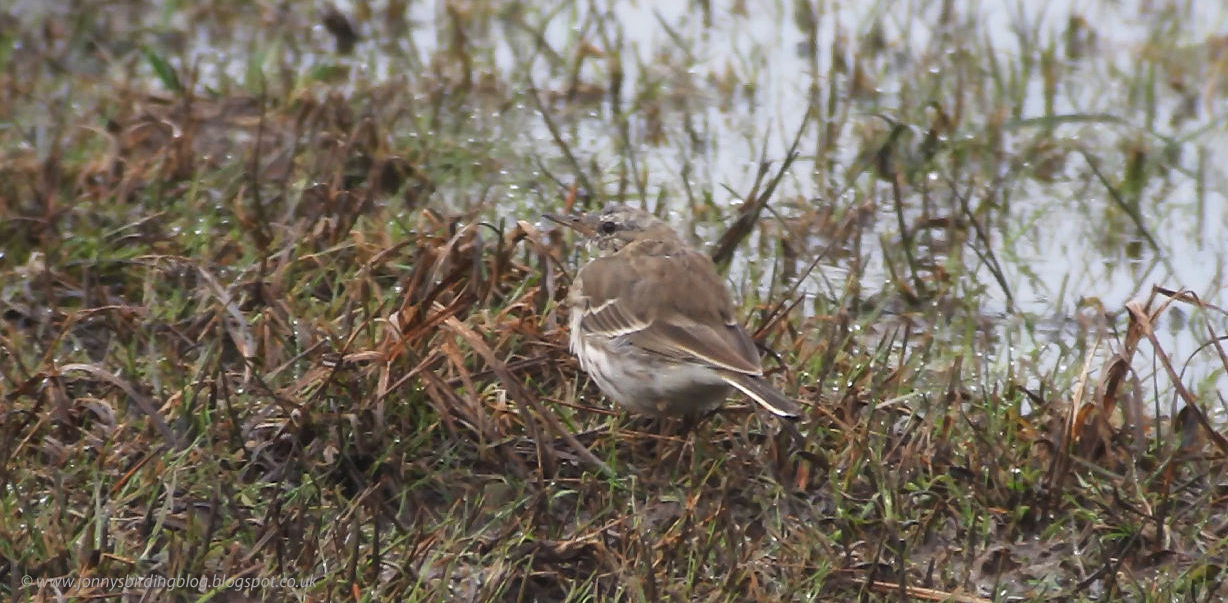
We took quite an indirect route home! Calling in at Low Newton, the Grey Phalarope was showing nicely on the scrapes, while a first-winter Glaucous Gull was in the field next to Monks House Pool. Finally, at Druridge Pools, a Water Pipit was showing well along with 36 Black-tailed Godwits, 4 Pintail and 2 Red-breasted Mergansers.
American White-winged Scoter - video should be viewed in HD at 1080p
Grey Phalarope - video should be viewed in HD at 1080p
Glaucous Gull
Water Pipit - video should be viewed in HD at 1080p
We were once again at the patch this morning, with a juvenile Glaucous Gull at Chevington being new for the year. Other additions were Kingfisher, Bar-tailed Godwit and Skylark.
Druridge Pools was busy with ducks again, and the recent hybrid wigeon was showing well. A smart bird. There were also quite a few waders today including 12 Black-tailed Godwits and 30+ Dunlin.
On the way back we stopped at Woodhorn where 7 Eurasian White-fronted Geese with the Greylags included the bird with the black neck ring '1V9'. I've attached its history below from geese.org...
Eurasian White-fronted Geese - including its ringing history
We were expecting a slightly quieter look at the patch on Saturday morning. However, once again the birding was better than expected...
With a bit of a north-easterly we decided to do a bit of seawatching from Hadston Carrs. We stayed about an hour but it proved very quiet. Moving south, Chevington was similar, although the Long-tailed Duck remained on the north pool. It had been joined by 7 Red-breasted Mergansers and another 5 Mergansers were on Ladyburn Lake. A short while later we had just been checking the geese when word came through of a White-billed Diver passing Whitburn.
With another sighting coming from Tynemouth shortly after, we rushed back to Hadston. When we arrived word had just come through of it passing Newbiggin and it had taken just 25 minutes to get between the two sites. So, when forty minutes went by and we still hadn't seen the bird, we thought we had missed out. However, we were really pleased when at 11:58 the White-billed Diver flew past nice and close inshore. A nice patch tick and our first Patchwork rarity of the year.
Other birds past Hadston on our second visit included 3 Velvet Scoters and 2 Ruff which were a bit unexpected. At Druridge, the number of Black-tailed Godwits had increased to 15, and a Water Pipit was giving good views even if it was a bit distant.
We finished the day at North Blyth, where 2 first-winter Iceland Gulls and a first-winter Glaucous Gull were showing across the river.
We've had a good run of seawatching this year with highlights up to today including Cory's Shearwater, Sabine's Gull, Storm Petrel and two White-billed Divers. We weren't as hopeful about today when we set off this morning, but were pleased to be proved wrong in the end!
We decided to start at Hadston Carrs and it wasn't long before we had our first Little Auk of the morning heading north. We stayed for two hours but it was pretty quiet with the highlight perhaps being a single Snow Bunting flying north past below the small cliff. Here's the totals for Hadston (09:30-11:30)...
2 Little Auk
10 Goldeneye
1 Long-tailed Duck
1 Little Egret
1 Snow Bunting
1 Great Northern Diver
3 Red-throated Diver
2 Great Crested Grebe
We then took a break for lunch and checked a quiet Druridge Pools before deciding to have another look at the sea from Snab Point. With rougher seas and the wind coming more from the north, our two and a half hours here were much more productive.
There were a few more Little Auks passing now and I got onto a distant Grey Phalarope which kept on disappearing behind waves. A second-winter Glaucous Gull suddenly appeared over the rocks and was close enough to make out the pale iris through binoculars. The Grey Phalarope reappeared much closer feeding in the surf and a second more distant bird flew north at speed shortly afterwards. After one had been seen earlier I was pleased to now be able add it to my finds list. Another finds tick for me came shortly afterwards when I picked up a lark flying straight towards us at distance. Despite the long range, its pale face was visible and as it got closer we could see that it lacked a white-trailing edge to the wings, confirming it as a Shore Lark.
It quietened down shortly after this but just as we were about to leave a Little Auk appeared flying over the rocks before landing in a rock pool, and I was able to get within a couple of metres of it, providing easily my best ever views! The totals from Snab Point 12:45-15:20 were as follows...
2 Grey Phalarope
16 Little Auk
1 Glaucous Gull
1 Slavonian Grebe
1 Great Skua
1 Manx Shearwater
3 Goldeneye
1 Goosander
1 Grey Plover
1 Shore Lark
Little Auk - second photo taken on my phone without any zoom!
I have to say we didn't really have great expectations for today when we first set off, but it turned out to be a really good day of summer birding...
First up was Druridge Pools (via Bell's Farm where there was a couple of Little Gulls). A Green Sandpiper was showing well in front of the screen and the number of Black-tailed Godwits had increased to 19. The three Spoonbills also flew off heading west. We then heard news of a possible Pacific Golden Plover, so, given it would be a lifer for both of us and presented a bit of an ID challenge, we decided to go for a look. My dad may also be able to catch up with the Corn Bunting...
Unfortunately it was quickly apparent when we arrived that our target was no longer in the Golden Plover flock, but the lingering second-summer Glaucous Gull was snoozing on the rocks and the Corn Bunting was still around.
Just as we were getting ready to leave, news came on of a White-winged Black Tern at Chevington so we headed back that way. By the time we got to the bay, the stunning adult summer White-winged Black Tern had moved to Druridge Pools where it showed nicely on and off for the next hour or so. Such good birds! Two Greenshank and a Ruff also appeared here.
Finally we had a look for orchids in the dunes at Chevington, which resulted in 5 different types being seen, and we also got onto a Red Kite moving inland which had been spotted just to the north by other observers, providing me with a very welcome patch tick!
Other good birds seen today included Avocets, Little Ringed Plovers, Common Sandpipers and a Little Owl.
Yesterday as spent mostly at Dunnington just east of York where we hoped to catch up with the Pine Bunting which had been wintering there. As we arrived at its favourite stubble field just off Kerver Lane we could see the birders on site all looking through their scopes and pointing. However, when we got to the group we were told "it was there 30 seconds ago!". Given that we'd heard some people had spent a day here without seeing the bird, I started to wonder if we'd missed our chance...
Thankfully we didn't have to wait too long (by this bird's standards at least!) as an hour and a half later we were all scrutinising the distant buntings at the other end of the field, when I noticed a bird land in one of the closest trees. I got in the scope and there was a male PINE BUNTING. What a bird! A lot brighter than we were expecting.
It wasn't long before it flew off again, however. Eventually the flock of buntings and finches started to move closer to us and they were once again joined by the Pine Bunting. At first it sat in the top of an alder for a minute or two before flying much closer and sitting in the hedge pretty close to us. We felt pretty lucky to get such good views.
The bird also had a great supporting cast in the stubble: 80+ Yellowhammer, 3+ Corn Bunting, Tree and House Sparrows, Goldfinches, Chaffinches, a few Reed Buntings and a single Brambling and Greenfinch.
Next we headed to Rufforth to look at the gulls. Stopping on the main road just south of the tip we saw 4 juvenile Glaucous Gulls on the tip and a flock of 9 Waxwings briefly landed in the trees overhead. Moving around the corner to Upper Poppleton, another juvenile Glaucous Gull was in the fields here, along with a second-winter. Six Glaucs in just over an hour isn't bad! 4 Red Kites were also seen from the car on our journey down from Northumbs.
A really good day and a big thanks to my uncle for driving us!
A catch up blog post today as increasing amounts of school work recently and a fractured wrist have left me with less time for editing photos and writing blog posts...
Greenland White-fronted Goose with the PFG south of Cresswell Pond yesterday afternoon, along with 8 Eurasians. 4 more Greenlands were at Longhirst as well as another 8 Eurasian White-fronts.
Iceland Gull in poor light at North Shields on the 12th.
Two juvenile Glaucous Gulls also at NSFQ...
Along with the impressive escaped falcon.
One of three Scaup at Linton Pond this afternoon.
'Continental' (sinensis) Cormorant phonescoped at Linton Pond.