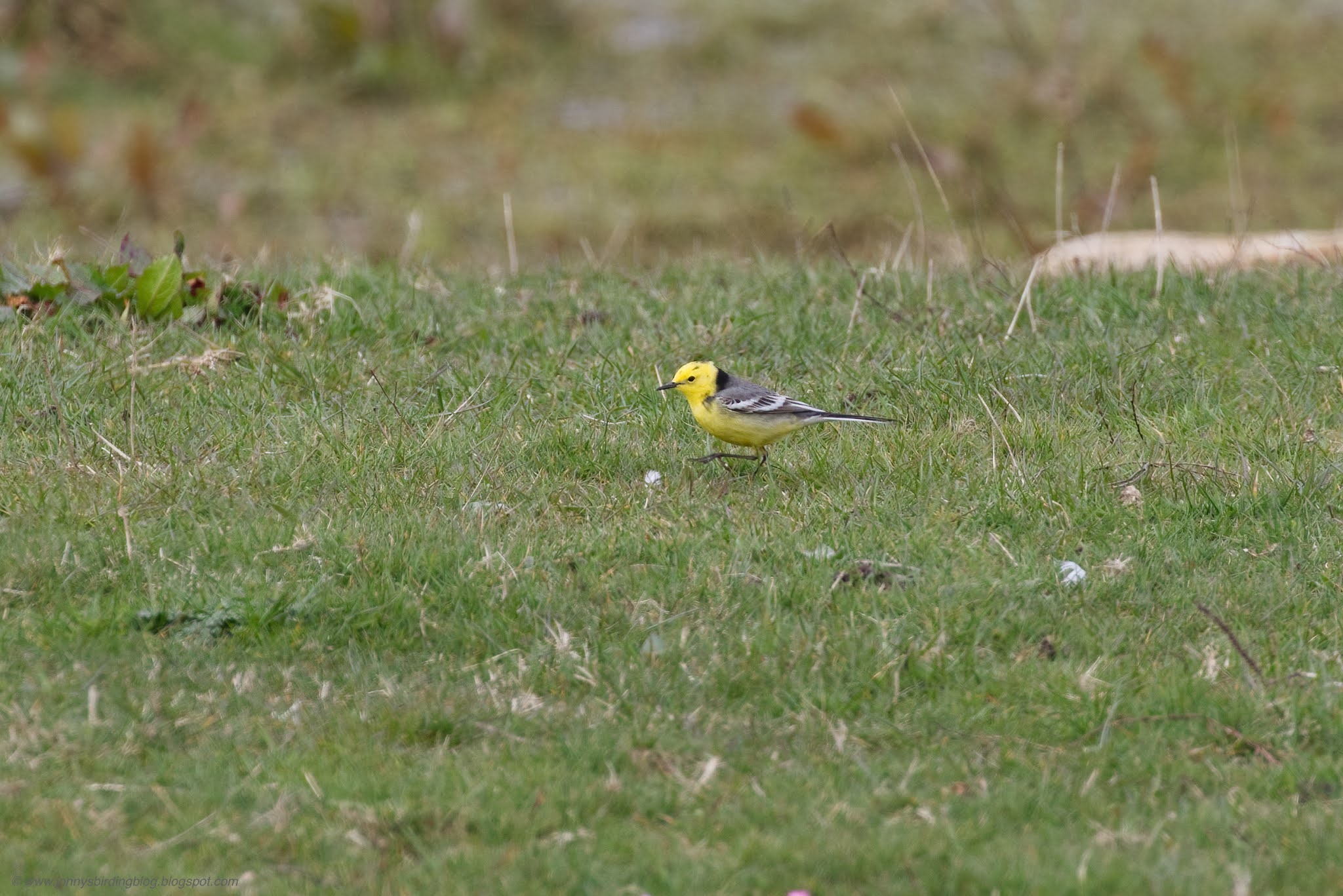
Despite less than ideal winds, spring has slowly started to get going since my last blog post. The undoubted highlight was the male Citrine Wagtail at Lynemouth Flash on the 3rd. An usual record being so early in the spring, and also because it turned up at exactly the same place as the showy female in 2017!
Other nice sightings have included the Todd's Canada Goose again, as well as an adult Greenland White-front and 3 Russian White-fronts, all in the Cresswell area, a Black Redstart at Snab Point, Glaucous Gull past East Chevington and my first Willow Warbler of the year.
Citrine Wagtail - please view the video in HD at 1080p
Todd's Canada Goose with the Pink-feet west of the hide at Cresswell
Here are a few of my highlights from the current lockdown (some taken with my DSLR and some phonescoped). It has been surprisingly productive despite having not been outside the five mile radius of my house!
Last week, I was able to finally return home to Northumberland for the first time since early September. On Wednesday (the 9th of December) I had gone out for the afternoon for a break from uni work. I decided to look at Hadston Carr for gulls, and was surprised by just how many birds were feeding in the stubble fields there.
There were thousands of gulls, Starlings, Woodpigeons and Pink-footed Geese, as well as over 100 Whooper Swans. As I scanned through the geese, I picked out an interesting looking Canada Goose with the Pink-feet. I was struck by how dark it was and barely larger than the surrounding Pink-footed Geese. I quickly realised this was most likely a vagrant Canada Goose, and asked for some other opinions which all came back positive. With its dark brown breast and body, dirty looking chin strap and small size, the Todd's Canada Goose (or perhaps even Lesser Canada Goose parvipes) really stood out from the feral Atlantic Canada geese a few fields away.
I put the news out, and the goose was seen by good numbers of birders until it disappeared on the 15th. The same day a Todd's was reported from Norfolk, so it seems likely that the Hadston bird has moved south with the Pink-feet (although I'm yet to see any photos of the Norfolk bird to confirm it's the same). Hopefully the my photos below will give a good representation of just how different it looked from our more regular Atlantic Canada Geese.
We headed out the house this morning with the intention of seeing my 300th species for the county. Our target was the Richardson's Cackling Goose in Budle Bay although we weren't too hopeful on the way as we'd only heard negative news so far...
When we arrived the difficulty of the task was apparent immediately. There were a minimum of 5000 Barnacle Geese and 2000 Pink-footed Geese and they were all very distant from the Harper's Heugh viewpoint. Eventually though a Canada-type was picked up asleep on the estuary.
Once it finally woke up it was hard to tell whether it was the Cackling or Todd's due to the extreme distance. However, this was made much easier when another birder picked up the Richardson's Cackling Goose in a much closer flock of Barnacles in one if the fields. It was quite distinctive when views were reasonable. Also at this point the Todd's Canada Goose woke up and walked around a bit.
Over the next hour or two the Cackling Goose returned to the bay before once again flying into the fields. My dad also picked up another Todd's Canada Goose in the bay feeding alongside a Greylag.
All photos and videos below were taken by S. Clifton and used here with permission. The videos should be viewed in HD...
Richardson's Cackling Goose - note how it is a similar size to the Barnacles, with a short neck, compact shape, square-looking head and a short bill.
The first Todd's Canada Goose - very distant on the mudflats, this was the smaller of the two Todd's though still noticebly bigger than the Barnacle. It's rear end was quite long, while it's neck appeared shorter than our 'native' Canadas. The breast also appeared quite dark.
Todd's Canada Goose number two - the larger of the two birds, its shape looked more similar to our normal Canada Geese, although it was visibly smaller than the nearby Greylag. British Canadas are almost always larger than Greylags.
And a video of each bird...
On the way home the Red-necked Phalarope at Druridge while a Slavonian Grebe and Velvet Scoter were off Chevington burn mouth.
A short trip to Druridge Bay today started at Druridge Bay Country Park, where 19 Waxwings flew over as well as a Woodcock. At Cresswell Pond there was 4 Whooper Swans, 2 Long-tailed Ducks and Common Scoter. The highlight of the day was a juvenile Great Northern Diver which me and my Dad found at Bothal Pond. There was also some Canada Geese which could be of the race interior or Todd's Canada Goose.