![]() |
| Taken at Los Molinos and near Vega de Rio Palmas, Fuerteventura on 20th and 22nd of February |
Monday, 15 April 2019
Wednesday, 10 April 2019
Common stuff...
Sunday, 7 April 2019
Fuerteventura: Trumpeter Finches
We had some fantastic views of a pair of Trumpeter Finches at Los Molinos Reservoir during our Fuerteventura holiday. The male was particularly showy as it sang from the rocks...
Saturday, 30 March 2019
Patch catch-up...
In between increasing amounts of schoolwork and editing photos from Fuerteventura, we have managed a few visits to the patch. Back at the beginning of March it was extremely quiet, except for a drake Green-winged Teal at Druridge Pools.
Last weekend things were slowly starting to pick up with a first-winter Glaucous Gull north through Druridge Pools being the highlight. An Egyptian Goose was also near Linton Pond.
Today, we headed out hoping to get some hirundines in the deteriorating weather conditions and East Chevington we were a bit surprised not to find any. However, at Druridge Bay Country Park there were at least 60 Sand Martin.
Another 10 Sand Martin were at Druridge Pools and we walked along the coal road to find the adult Bewick's Swan still among 62 Whoopers. As we watched the swan, we picked up a Great White Egret flying towards us from the west and it appeared to land on the shore of the main pool. We rushed back to the hide and at first there was no sign, but my dad picked it up in the SW corner. Unfortunately the views were pretty poor but it was nice to finally find one for ourselves!
A Velvet Scoter and Sandwich Tern were offshore.
![]() |
| Bewick's Swan |
![]() |
| Great White Egret |
![]() |
| Green-winged Teal |
![]() |
| Snipe |
Saturday, 23 March 2019
Fuerteventura: Pallid Swifts
In order to get my Fuerteventura photos onto my blog a bit quicker, I'm going to post a number of species posts about individual species from the last few days of our holiday in February.
Here's the first set, featuring photos of a showy group of 15+ Pallid Swifts over Las Parcelas, near Los Molinos Reservoir...
![]() |
| Pallid Swifts |
Saturday, 16 March 2019
Fuerteventura Day 4: Southern Sibe
After a busy first few days to our trip, we fancied our fourth day being a bit more relaxed. We spent the morning at Faro de Toston just north of our apartment in El Cotillo.
It was the most productive site for waders we visited during the week, with over 60 Ringed Plover and 20 Kentish Plover on the various small beaches. Other waders were 3 Whimbrel, a Grey Plover, 2 Turnstone, 5 Common Sandpiper and 3 Dunlin. Some showy Berthelot's Pipits were around the point, along with 2 Trumpeter Finches and 4 Sandwich Terns.
For the afternoon we drove to the Fimapaire Valley, just east of La Oliva. We didn't expect very much here but had a nice surprise when I found a Yellow-browed Warbler in a small patch of willows in the west end of the valley. A flock of 40+ Spanish Sparrows and several Hoopoes were also in the willows.
The valley was good for Laughing Doves with several flying around the various goat farms. Southern Grey Shrikes were easy to see and flyovers included an Egyptian Vulture, Ruddy Shelduck and a group of 11 Pallid Swifts.
![]() |
| Yellow-browed Warbler |
![]() |
| Southern Grey Shrikes - adult and juvenile |
![]() |
| Berthelot's Pipit |
![]() |
| Kentish Plover |
![]() |
| Common Sandpiper |
![]() |
| Laughing Dove |
![]() |
| Barbary Ground Squirrel |
| Yellow-browed Warbler habitat |
Sunday, 10 March 2019
Fuerteventura: Day 3 - Tindaya Plains
On our third day on Fuerteventura we made the short journey south from El Cotillo to Tindaya Plains. This is possibly the best site on the island to catch up with the desert specialities, and on our first visit we definitely were not disappointed.
The key to viewing at this location is to slowly drive along the tracks in the car, scanning every so often. The birds can then often be seen at close quarters from the car. Once we arrived it wasn't long until we spotted a pair of Stone-curlews sat just metres from the track. They were totally unfazed by us despite the incredibly close range. We were treated to our best views of the species by a long way!
We continued west along the main track, and quickly picked up a group of four Houbara Bustards. One female cam particularly close. Berthelot's Pipits and Lesser Short-toed Larks were both present in good numbers across the plains.
We reached a crossroads, and here we located a loose group of very smart Cream-coloured Coursers numbering six in total, including two juveniles. This was also a particularly good place to see Lesser Short-toed Larks.
The track continues all the way down to the coast (although deteriorates and is almost impassible in places) and we decided to drive down its full length. We saw a total of five more Houbara Bustards including one which flew past the car and another which just sat preening close by. Our first two Black-bellied Sandgrouse of the trip flew over too along with a Ruddy Shelduck.
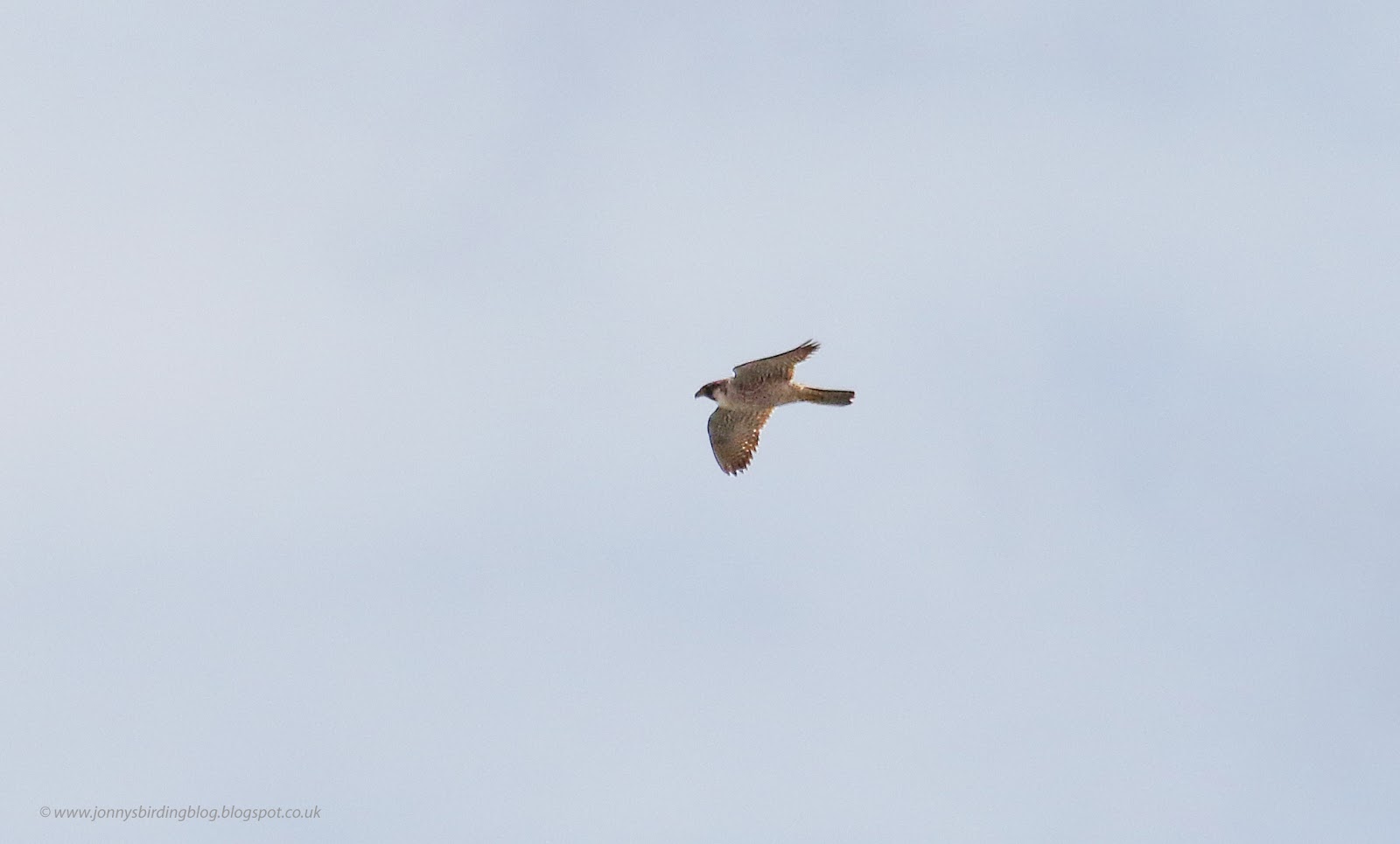
On reaching the end of the road, we had a look offshore where around ten Cory's Shearwaters were milling around and nineteen Gannets flew past north. A Barbary Falcon flew over our heads here.
Encouraged by our success here, we decided to head back to Barranco de Rio Cabras for another go at seeing the Dwarf Bittern. Again there was no sign, but I did find a Spotted Crake under the tamarisks and a Greenshank was also new, along with most of the birds on my previous post.
![]() |
| Houbara Bustards (ssp. fuertaventurae) |
![]() |
| Lesser Short-toed Lark (ssp. polatzeki) |
![]() |
| Cream-coloured Courser - I was after more photos later in the week! |
![]() |
| Stone-curlews (ssp. insularum) |
![]() |
| Black-bellied Sandgrouse |
![]() |
| Berthelot's Pipit in the only ten minutes of rain during the trip! |
![]() |
| Barbary Falcon |
![]() |
| Spotted Crake |
![]() |
| Little Ringed Plover |
Subscribe to:
Posts (Atom)